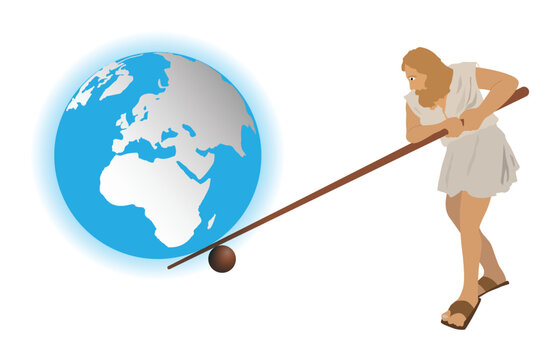
The Greek mathematician Archimedes famously said, "Give me a lever and a place to stand, and I can move the Earth." Now, this guy was no ordinary math whiz – he was like a superhero of ancient Greece, using his brain to outsmart enemies and solve crazy problems.
But what did Archimedes mean by "a lever and a place to stand"? Well, a lever is basically a long stick or bar that you use to lift or move heavy things, and the "place to stand" refers to the fulcrum, or the pivot point, of the lever. Think of it like a seesaw, but instead of kids playing on it, you're using it to lift massive weights – or, you know, planets.
Now, let's talk about the physics behind Archimedes' claim. You see, when you use a lever, you can amplify the force you apply, making it much easier to lift heavy objects. It's like having a superpower – but instead of flying or being invisible, you can just lift really heavy stuff! And the longer the lever, the more force you can apply.

