
At its core, a plug-in solar panel kit is just a mini power plant for your home. Think of it as a sun-fueled battery charger for your entire household—or at least a few outlets.
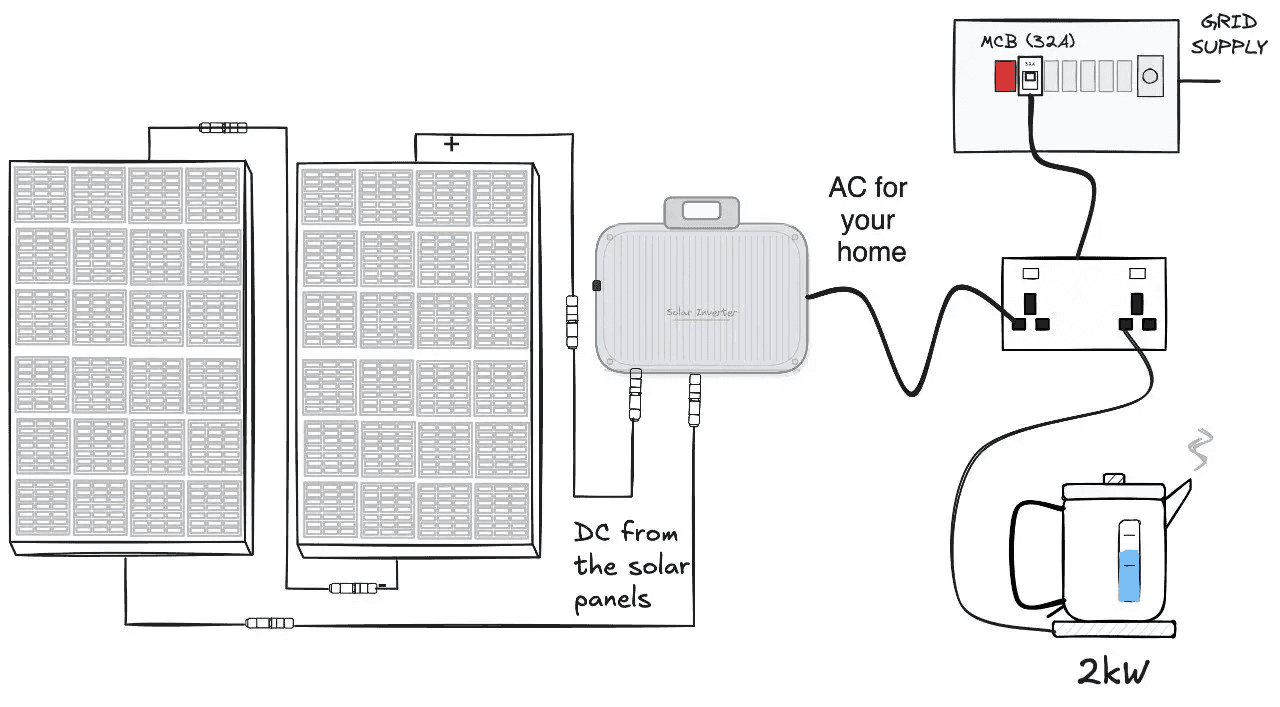
You set the panels outside (a balcony, a patio, or even a sunny patch of lawn) and connect them to a special microinverter. This little box is the brains of the operation, converting the sun’s direct current (DC) energy into the alternating current (AC) your house uses.
From that microinverter, a simple cable runs to a standard wall outlet inside your home. You just plug it in. It’s that non-dramatic. No permits, no roof drilling, just a satisfying click.
But Wait—Doesn’t That Backfeed Power into the Grid? (Spoiler: Yes, but Safely!)
Here’s the clever part: your home’s electricity flows like a river. When you plug in your solar kit, the power from the panels meets the power from your utility company.
Your appliances use the solar power first, because it’s right there in the circuit. If you’re making more solar juice than you’re using (say, while you’re at work), the excess gets pushed back into the grid—and your meter might even spin backward!
Worried about safety? Don’t be. The microinverter is a safety superstar. It constantly monitors the grid voltage. If the grid goes down (like during a power outage), it immediately shuts off the solar flow to protect utility workers. You’re basically a tiny, harmless power plant.
 Plug-In Solar Panel Systems: How They Work & UK Home Guide (2026)

