In the simplest terms, a vertex (plural: vertices) is a corner or a point where two or more lines, edges, or rays meet. Think of the tip of a triangle or the peak of a pyramid.
Every shape you see in geometry—from a simple square to a complex dodecahedron—is built from vertices. They’re the skeleton’s joints, honestly.
Don’t let the fancy word scare you. If you’ve ever played with a corner of a pizza slice, you’ve already met a vertex. (And probably eaten it, too.)
Polygons: the vertex party
In 2D shapes like polygons, vertices are where the sides meet. A triangle has three vertices, a square has four, and a pentagon has—you guessed it—five.
Here’s a fun trick: count the corners of any shape. That’s your vertex count. No memorization needed. You’re welcome.
This is why a circle technically has zero vertices. It’s a smooth, never-ending curve. No corners, no drama. Unlike that flat-pack shelf.
Let’s go 3D: cubes, pyramids, and you
Now, step into the third dimension. A cube—like your dice or that infuriating Rubik’s cube—has 8 vertices. Each corner is where three edges intersect.
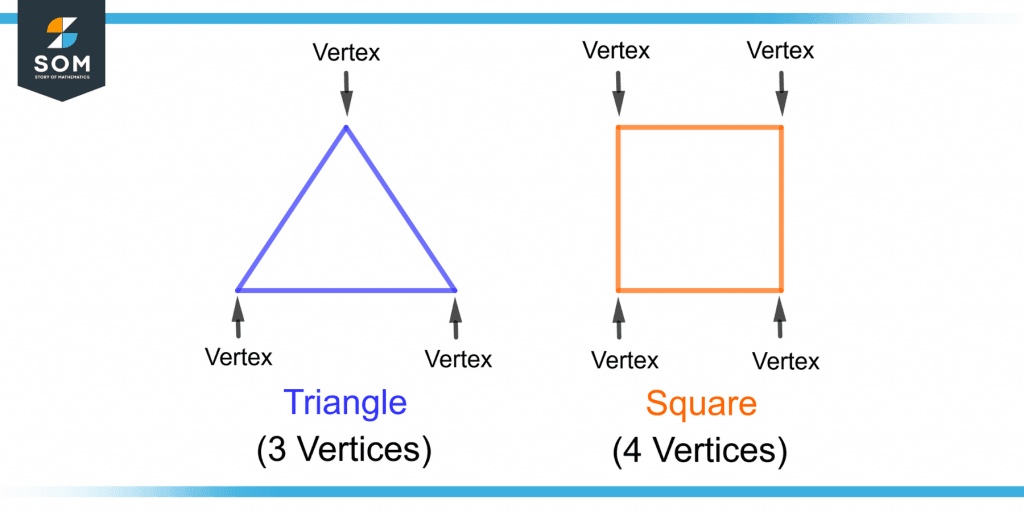 Vertex
A pyramid? Four vertices at the base (if it’s square) plus one at the tip. That makes five vertices total. But here’s where people trip up: the tip is only a vertex if it’s pointed. If it’s flat, it’s a face. 😉
Why does this matter? Because vertices define shape. Change the number of vertices, and you change the whole object. A cube without its eight corners becomes a sphere. Try that in real life—good luck.