
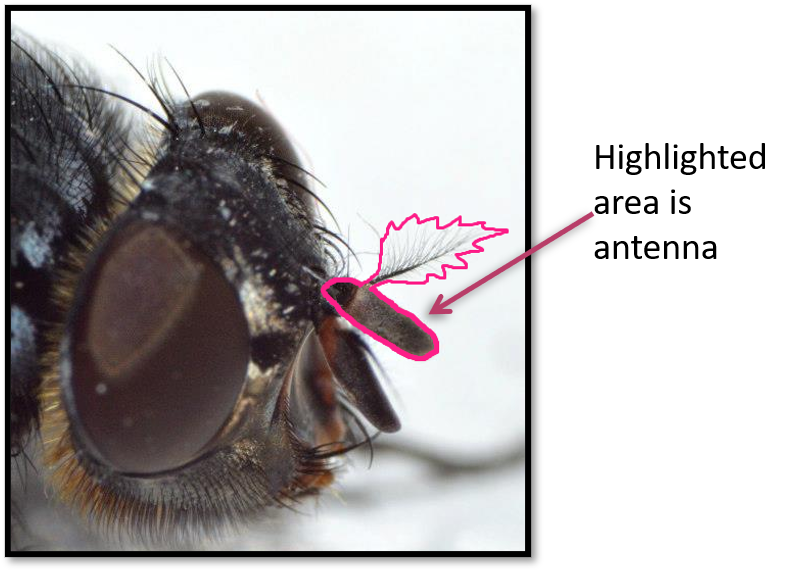
If you look closely at a house fly’s head—right between those gigantic, compound eyes—you’ll spot two tiny, feathery nubs. These are called aristae, and they’re basically fancy bristles attached to the antenna shaft. They look like a microscopic bottlebrush glued to a chopstick.
Why so small? Because house flies don’t need 3D radar like some insects. They rely on smell, touch, and air movement to navigate. Those little antennae are like the Swiss Army knife of senses—tiny but packed with power.
Think of them as the fly equivalent of a swipe-left Tinder user: they detect pheromones and food scents instantly, but they’re not going to parade around with showy antenna feathers. Efficiency over vanity.
What Do They Do With Those Stubs?
Imagine trying to smell a pizza from across the room while someone sprays you with a garden hose—that’s a fly’s daily reality. Their antennae are chemical receptors that pick up odors, moisture, and even carbon dioxide. Yes, your exhaled breath is basically a beacon screaming, “Free snacks here!”
But wait, there’s more. Those aristae can also feel air currents. When you swing a rolled-up newspaper, the fly’s antennae detect the pressure wave and say, “Time to do the cha-cha—outta here!” That’s why you always miss.
In fact, their antennae are so sensitive that flies can detect temperature changes and humidity. So if your kitchen is too dry, they’ll buzz straight to your moist bathroom. Talk about a sensory spa day.
 What are Gnats? Are Gnats Flies? | Ask an Entomologist

