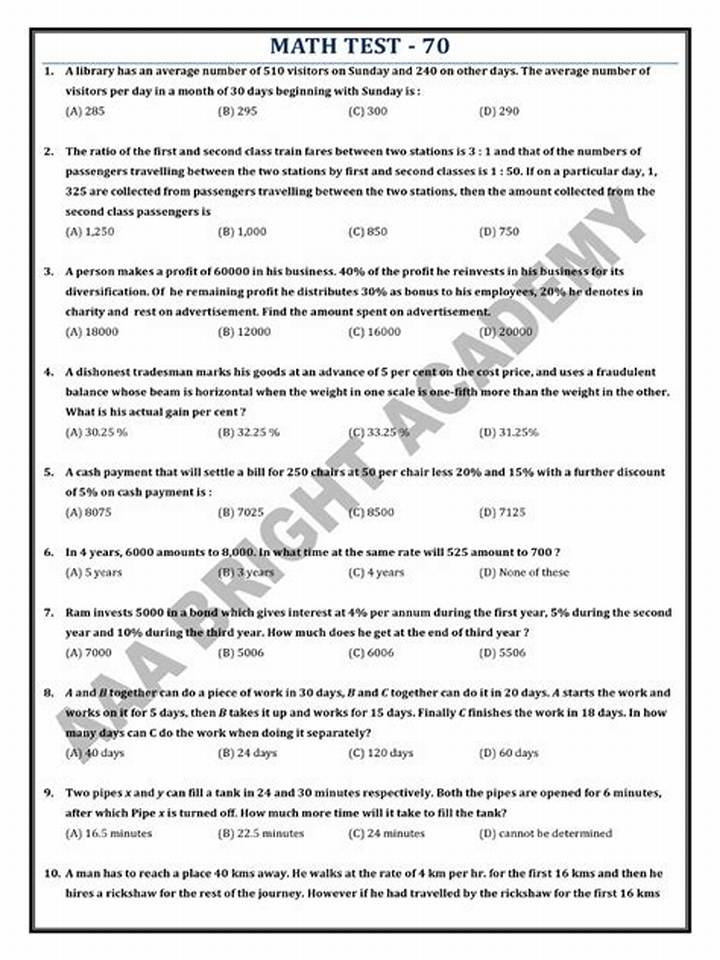
Students often ask—quietly or out loud—what it would take to go from 70 to 80 or 90. The truth is that the jump usually requires deeper consistency: fewer arithmetic errors, faster problem setup, and better handling of multi-step questions.
At 70, you can miss some items and still pass. At 90, you typically can’t. That’s why the study plan should change as your confidence rises.
| Goal | Main focus | What you can afford to miss |
|---|---|---|
| 70% | Reliable basics, partial credit steps, and quick word-problem setups | Several medium problems or a few hard ones |
| 80% | Fewer careless mistakes, stronger algebra manipulation, more accurate checking | Some medium problems, occasional hard ones |
| 90% | Consistency under time pressure; minimal arithmetic and concept slips | Very few problems, usually only the hardest ones |
Notice the pattern: higher scores demand tighter execution, not just more studying. That’s where practice with feedback and timed conditions becomes essential.

