What Are The Ingredients In Cool Whip
So, picture this: It’s Thanksgiving, and my Aunt Carol has just unveiled her “famous” strawberry fluff dessert. She beams as she plops a mountain of white, cloud-like goodness...
So, picture this: It’s Thanksgiving, and my Aunt Carol has just unveiled her “famous” strawberry fluff dessert. She beams as she plops a mountain of white, cloud-like goodness onto the table. For years, I thought she spent hours whipping cream from scratch. Then, one day, I spotted the tub: Cool Whip.
My whole world tilted. I mean, how could something so fluffy and stable be a product of a factory, not a farm? That little plastic tub holds a fascinating, slightly unsettling, chemical masterpiece. And today, we’re cracking that lid open—metaphorically, of course—to see what’s really inside.
Let’s start with the obvious: water. It’s the first ingredient, which makes sense because Cool Whip is mostly air and water. But don’t let the “water” fool you—this isn’t just cloud juice.
Next up is hydrogenated vegetable oil (usually coconut or palm kernel oil). Here’s the kicker: “hydrogenated” used to mean trans fats, but today’s version is fully hydrogenated. That means zero trans fats, but it’s still a processed solid fat. Think of it as the structural scaffolding that keeps your pie topping from collapsing into a puddle.
Then comes high fructose corn syrup and corn syrup. Yes, there’s sugar, and then there’s more sugar. Why two syrups? Because manufacturers want that perfect sweetness without crystallization. It’s like they’re building a sugar skyscraper. And honestly? Your taste buds aren’t complaining.
You’ll also spot modified food starch. This is a sneaky thickener that mimics the richness of real cream. It’s derived from corn, potatoes, or tapioca, and it basically says, “Hey, look at me—I’m creamy!” Spoiler: it’s not, but the illusion is strong.
Now, let’s talk stabilizers: sodium caseinate (a milk protein) and cellulose gel. Sodium caseinate gives a tiny hint of dairy, while cellulose gel is literally wood fiber. Wait, don’t freak out. It’s purified plant fiber that helps trap air. So, yes, your Cool Whip is part tree. (Eat your fiber, kids!)
And we can’t forget polysorbate 60 and sorbitan monostearate. These are the emulsifiers—the peacekeepers between oil and water. Without them, your dessert would separate into a greasy mess. They’re the reason you can scoop a perfect dollop onto your pumpkin pie without drama.
There’s also natural and artificial flavor. Bet you thought “natural” means vanilla beans? Nope. “Natural flavor” can come from a lab-engineered yeast or plant extract. And the “artificial” part? That’s usually vanillin, a synthetic vanilla knockoff. It’s cheap, it works, and you’ve never noticed the difference.
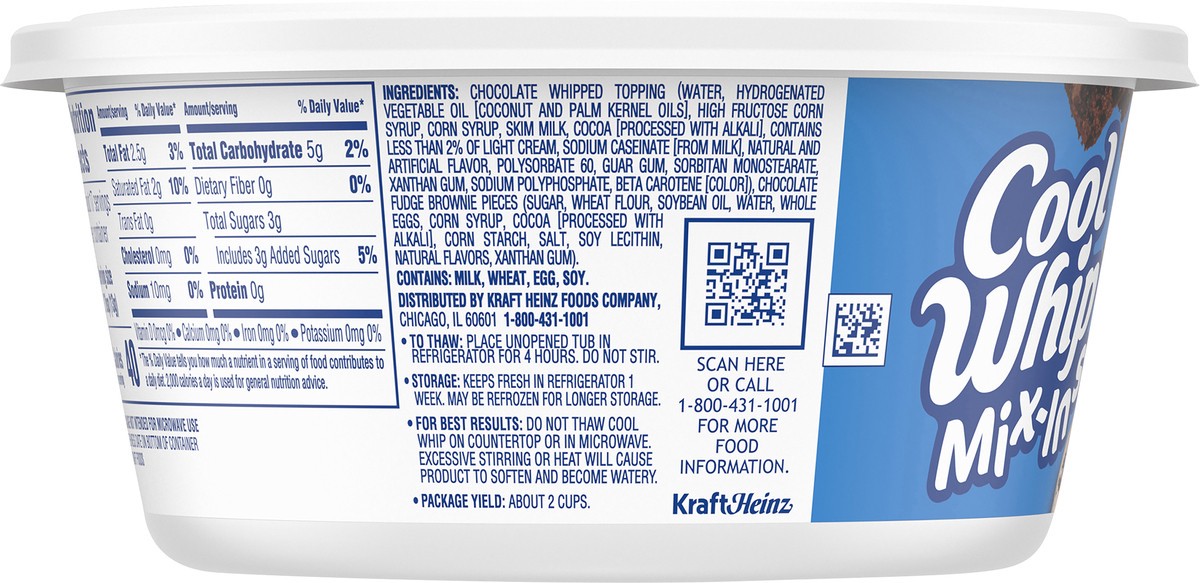 Cool Whip Mix-Ins Double Chocolate Brownie Whipped Topping, 8 oz
Let’s not overlook xanthan gum and guar gum. These are the bouncers at the texture club. They keep the foam springy and prevent ice crystals from forming. You know how real whipped cream gets watery after an hour? Cool Whip laughs at time. It’s the Terminator of toppings.
Oh, and there’s beta carotene (for color). That makes it look slightly yellow—just like real cream. It’s a PR move for your eyes. The actual foam would be a sad grayish-white without it.
Finally, sodium acid pyrophosphate. This is a chemical buffer that controls acidity. It sounds scary, but it’s also found in baking powder. In Cool Whip, it keeps everything stable during transport. Because nothing ruins a holiday like a deflated tub of disappointment.
So, is Cool Whip “real food”? Well, no. It’s a triumph of food science designed to survive your fridge for two weeks. Real whipped cream spoils in two days. Cool Whip? It’ll outlast your leftovers and probably your New Year’s resolutions.
But here’s the ironic part: I still love it. There’s a certain honesty in a product that doesn’t pretend to be dairy. It’s a topping, a stabilized foam, a modern marvel. Aunt Carol’s dessert still tastes like childhood, even if the ingredients read like a chemistry textbook.
Next time you peel off that plastic seal, think of the hydrogenated fats and gum acacia doing their microscopic dance. And remember: you’re not just eating dessert—you’re eating engineering. No judgment here. Just a spoonful of curiosity.