
Here’s the dirty little secret: a “glass” is not a standard measurement. Not in the kitchen, not in the science lab, and certainly not in your aunt’s cupboard. The official U.S. cup is exactly 8 fluid ounces. A standard pint glass? That’s 16 ounces—or two cups.
But your fancy tumbler from that hotel? Maybe it holds 12 ounces (that’s 1.5 cups). And that huge mason jar you use for iced coffee? We’re talking 24 ounces—three cups of water. See the chaos? You’ve been ordering a “glass of water” your whole life, but you’ve actually been ordering a variable geometry problem.
Why This Actually Matters (Besides Annoying Your Aunt)
Let’s get real for a second. You’ve heard the “eight glasses of water a day” rule, right? Well, if your “glass” is a tiny juice glass from the 1950s (maybe 4 ounces), you’d need to drink sixteen of those to hit your goal. But if you’re using a big Nalgene bottle, you’d drown yourself after two refills.
Here’s the irony: the whole “eight glasses” advice was based on a vague guess. The Institute of Medicine actually recommends about 3.7 liters (15.5 cups) for men and 2.7 liters (11.5 cups) for women. But nobody says “I need 11.5 cups today.” They say, “I need a couple of glasses.” Facepalm.
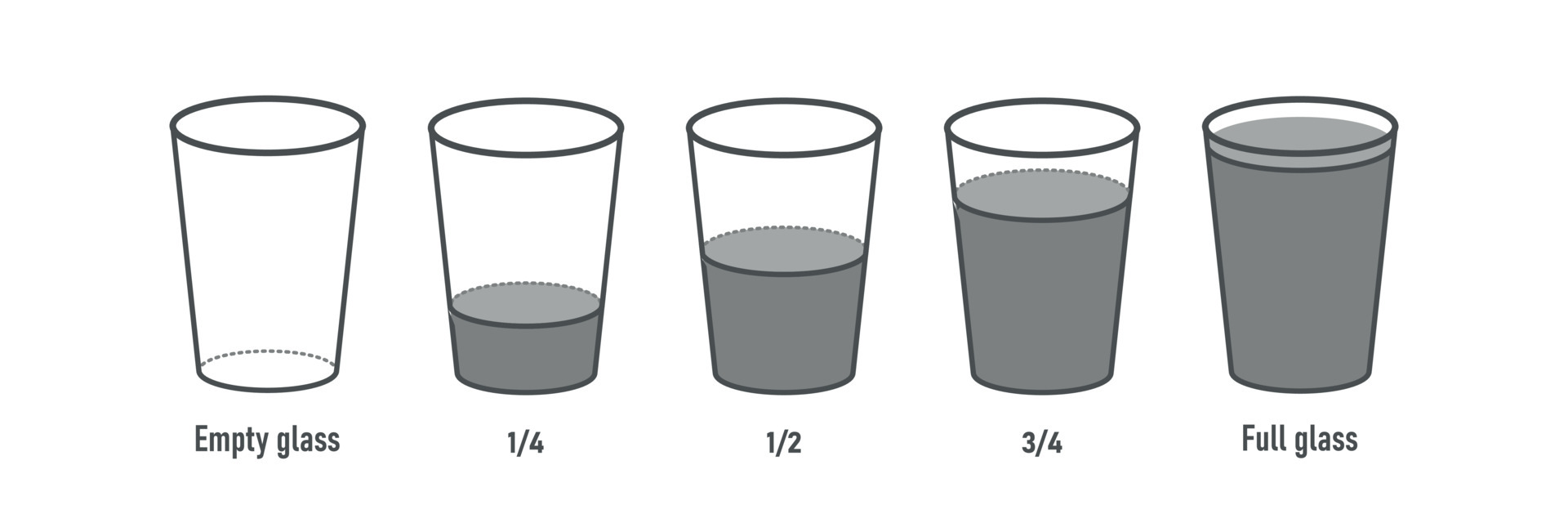 Volume water. Liquid of glasses empty half full quarter. Bulk fractions

