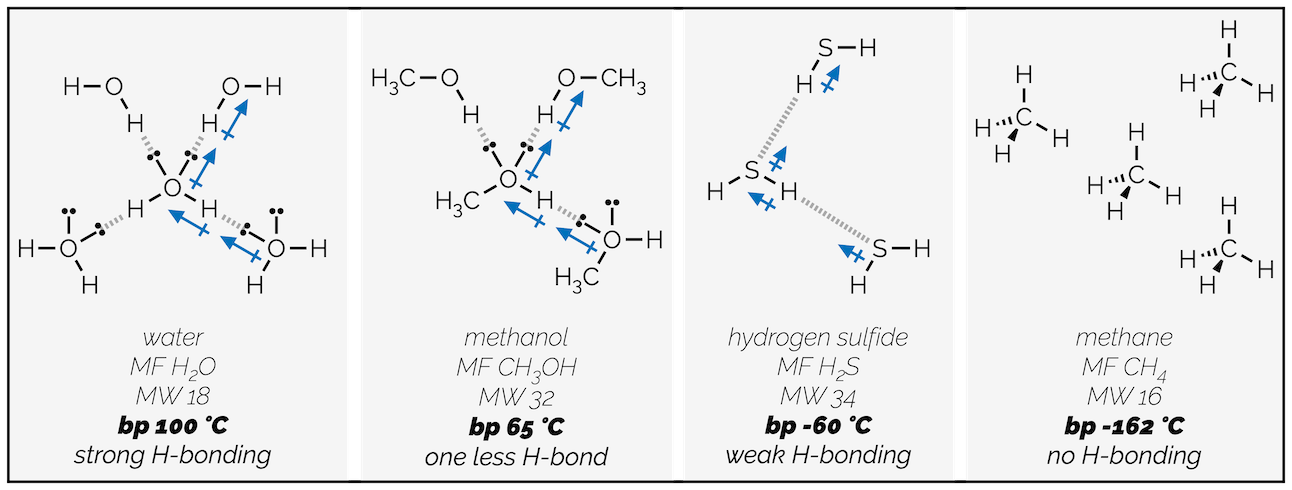
Here’s where it gets nerdy-fun. Look at the other molecules in water’s family: H₂S (hydrogen sulfide), H₂Se, and H₂Te. They are all heavier than water! You’d think they’d boil higher, right?
Nope. H₂S boils at a putrid -60°C. H₂Se and H₂Te boil higher, but still below water’s 100°C. Why? Because they don’t form strong hydrogen bonds. They just have boring, weak attractions.
 Polarity Part 2: Intermolecular Interactions & Physical Properties
Water is the overachiever in the family. It gets a massive “boost” from its hydrogen bonding abilities. It defies the normal trend of “bigger = higher boiling point.” It’s a rebel with a sticky cause.
It’s not just about boiling, though
This stickiness affects everything. It’s why water has such a high surface tension (you can float a paperclip on it!). It’s why ice floats (the hydrogen bonds make a crystal structure thin and less dense!). And yes, it’s why you sweat to cool down.
When you sweat, those water molecules need tons of energy to evaporate. They steal that heat from your skin. Without hydrogen bonding, sweating would be useless, and you’d be a crispy friend right now. So, thank you, hydrogen bonds.
Even DNA uses hydrogen bonds to keep its famous double helix zipped together. If those bonds were weaker, we’d all just be a puddle of genetic goop. Yikes.