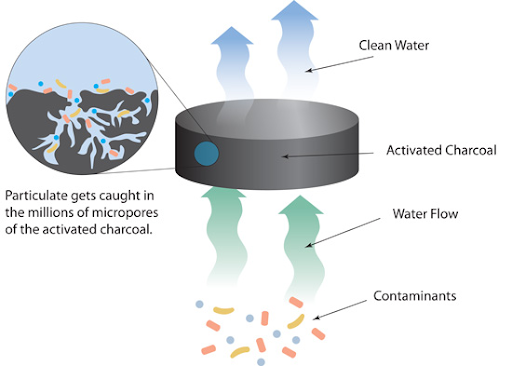
Think of activated charcoal as a tiny, super-powered sponge. Before it’s “activated,” regular charcoal is just burnt wood or coconut shells—kind of like the stuff in your barbecue. But then, it goes through a special process where it’s treated with gas or heat. This opens up millions of tiny pores inside each particle.
Imagine a single grain of sand suddenly developing a labyrinth of tunnels inside it. That’s what activated charcoal looks like under a microscope. These pores create a massive surface area. In fact, just one teaspoon of this stuff has the surface area of a football field. Wild, right?
So when water flows over or through this charcoal, something cool happens. The charcoal plays host, but it only invites certain guests.
Adsorption: Not Absorption
Here’s the key trick: it’s not “absorption” like a paper towel soaking up water. It’s adsorption (with a ‘d’). This means impurities in the water stick to the outer and inner surfaces of the charcoal pores like static cling. Chlorine, some pesticides, and chemicals that give your tap water a weird smell or taste get trapped.
It works because of a little thing called van der Waals forces (fancy physics term, but just imagine tiny magnets). The charcoal attracts these unwanted molecules and holds them tight. The clean water flows right through, leaving the “bad stuff” behind.
It’s like having a bouncer at a club who only lets the cool, clean water molecules in, while keeping the smelly, chemical-looking characters out. Simple, but effective.

